
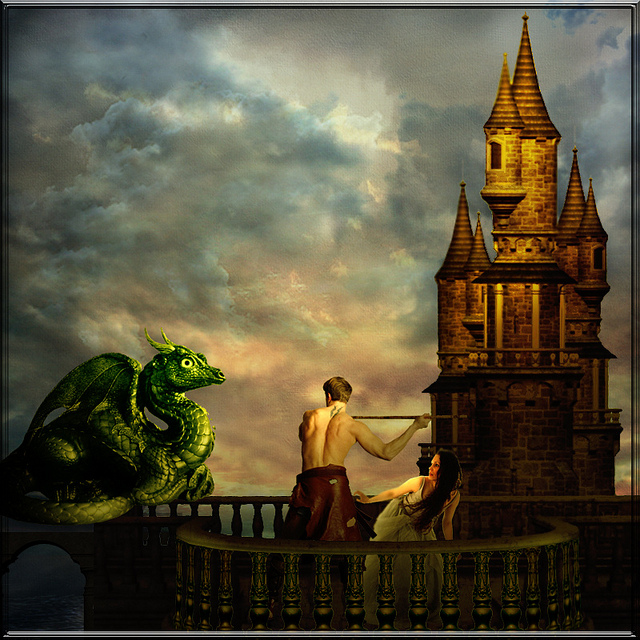
We fantasy readers want a champion we can root for, suffer with, struggle alongside, and ultimately cheer on. If our fantasy heroes too wondrous, too cold, or too inhuman, we are apt to quickly lose interest. And when you don’t care what happens to a story’s characters, the story’s sunk.
Here are five traits with examples from published works (and from my own Curious Origins of a Restless World) that I believe make for good heroes in fantastic settings:
1. Mission – Paul Atreides in Dune
Fantasy stories are all about a hero’s undertaking.
Say what you will about Dune’s protagonist; he might have overly relished his messiah-type role, he might have been a tad blood-thirsty, but Paul Atreides had a definite mission in mind and he stuck to it. His focus drew others into his vision. He galvanized his followers into action.
Even the desert was no match against his purposes. I mean… good night – he tamed sandworms!

Paul Atreides photo creditJohn Spooner via photopin cc
A fantasy hero, whether he’s on a quest or merely dealing with what is coming at him, needs a mission to carry him forward. It might start only as a purpose he’s contemplating, one he’s reluctant to take, but a goal gives him and the story direction…
And conflict.
In my own Restless World series, the common fisherman Mantvor comes faces a merciless enemy. His fright pushes him to act in order to save what is most important to him, that is, his livelihood, his home, and his family. Over the course of three stories, he envisions his task, plans it, and sets his face to do it. Obstacles he confronts drives him and his story forward to the end of the book.
Mantvor does find the fulfillment of his mission… and its price.
2. Morality – Lucy Pevensie in The Chronicles of Narnia

Lamppost photo credit: JMC Photos via photopin cc
Willingness to pay the price in completing a mission arises from the hero’s sense of goodness.
From the first Narnia book C.S. Lewis wrote, Lucy demonstrates an innate sense of right and wrong, of what is true and what is just. She is the first of her siblings to grasp what is really going on in Narnia and what the stakes are. They refuse her advice to their own detriment. Through her simple faith in good, C.S. Lewis gives his story a moral compass in human terms…
Lucy’s moral compass even directed a faun to better decisions.
A villain acts for what is good for himself, for his end. He sees no reason to sacrifice himself, though he may readily ask others for sacrifice. In contrast, a hero is convinced there is something greater at risk than his own skin and his own happiness. A fantasy hero does what is right no matter the cost…
And it’s mostly a steep cost.
While working for the good of his people, Prince Tryvenlork in “The Apprenticeship of Heroes” is thwarted at every decision and by those who most likely should be working with him. He carries on through near hopelessness because he is convinced that what he is working toward is right and good, that the future matters even as the present falls to pieces.
The little light – that tiny good a hero shows in the overwhelming darkness of evil – binds us readers to him or her.
3. Endurance – Frodo Baggins in The Lord of the Rings
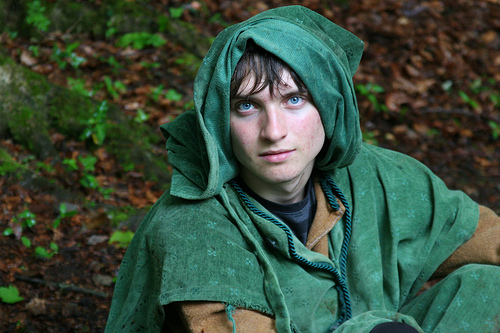
Frodo Baggins photo credit: FateDenied via photopin cc
Against crushing adversity, our heroes need fortitude.
Frodo Baggins is the epitome of endurance. Through three long books he braves trials and tortures as he doggedly proceeds on his bleak assignment. He endures, and so does Samwise. Once the deed is done, the two wait for death and see from afar a better time for those who will come after.
But ho! Gandalf sends them the eagles. (Why didn’t he do that earlier?)
A hero’s determination in the face of overwhelming odds keeps the reader turning the pages to find what will happen next…
And how endurance will win the day.
The second protagonist in “The Apprenticeship of Heroes,” the bereft and exiled Lamber, endures years of enslavement and torture. He desires the release of death but waits for an answer to seemingly unanswerable questions of purpose and existence. He ends surprised by how endurance has directed him.
Endurance harks back to mission and forward to courage.
4. Courage – Dorothy Gale in The Wizard of Oz

Courage is fear met with action.
Though you may think it a children’s book and movie, The Wizard of Oz (whether book or movie) gives a great example of courage. Dorothy’s search for home moves her to confront fearsome adversaries with what little resources she has. In her struggles, she discovers a resource she didn’t know she possessed: her own courage.
By her courage her friends obtain their dreams, flying monkeys get their freedom, and her enemy melts away – literally.
Courage is more startling when the hero is obviously not up to the task, whether physically, socially, mentally, or emotionally. That’s why fantasy stories with children facing mortal danger hit such a note with readers. But all fantasy heroes must face fear and must push on…
And that’s courage.
Throughout the second story of Curious Origins of a Restless World the captured Princess Hothana seeks a way to be a hero for herself, her people, and her gods. She has little with which to work. Yet in her limits she discovers her role, her strength, and a solution.
It’s pesky personal limits that force a hero to find courage.
5. Imperfections – Harry Potter in The Harry Potter Series
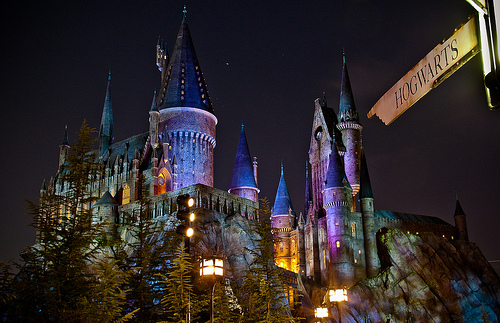
Hogwarts photo credit: Scott Smith (SRisonS) via photopin cc
Those limits many times are from the hero himself.
Harry Potter doesn’t always do the right things. He breaks the rules; he makes mistakes; he gets in jams he should have known better to plunge into. Often his self-made messes propel the story. As readers we want to warn him; we want to say, “No, Harry; listen to Dumbledore; listen to Hermione.” Yet despite Harry’s imperfections, we hold that his heart is compassionate, seeking good not only for himself but for others.
A hero too perfect easily becomes boring. We want to identify with the protagonist. If he or she never makes a mistake, then there is barely any conflict and certainly no connection to us frail humans. For this reason, Superman is always in search of a worthy villain who possesses a lump of Kryptonite…
And knowledge of his vulnerability in saving humanity.
Cruel, barbaric Thoomo in “Death Wind” has moral flaws down to his bones. He makes grievous mistakes and commits blatant evil. Yet during the progress of his story, Thoomo keeps an honesty in his search for what is true. By the end of his story, we hope this honesty guides him to making the wise choice, that one, supreme good decision.
The above five traits are not the only ones needed for a memorable heroic character, but they do underlie the heroes and heroines we hold close. We want them to overcome.
For as our heroes overcome, there is hope for us.
0 Comments
Trackbacks/Pingbacks